Measuring What AI Can Actually Do: Occupational Exposure Beyond Fluent-but-Flawed Outputs
Current AI occupational exposure indices conflate surface fluency with domain reliability. We introduce the *AI Exposure Evaluation Pipeline* — a teacher–student–judge LLM framework across 114 O\*NET occupations — and identify the *Fluent-but-Flawed* phenomenon: a persistent Clarity–Domain Accuracy gap (mean: 1.55–1.90/5) that constitutes a critical RLHF-induced measurement bias.
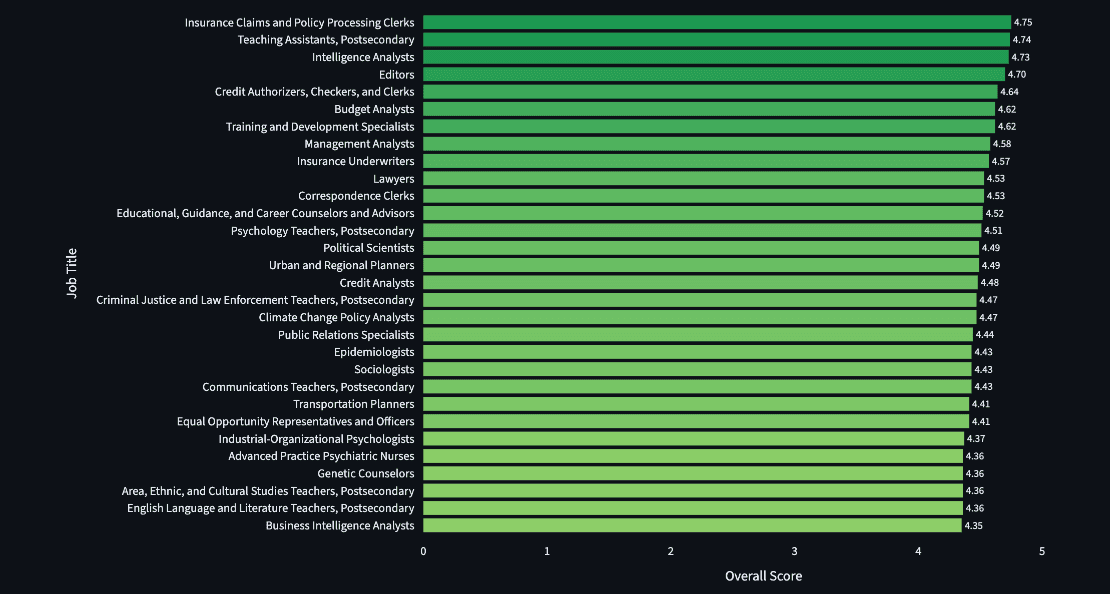
Measuring What AI Can Actually Do: A Task-Level Decomposition of Occupational Exposure Across O*NET Roles
By Hao Zhang & The Butterfly Labs Team Aug 28, 2026
When evaluating AI occupational exposure, is "can the model do it?" the right question to ask? Our recent experiments at Butterfly Labs reveal a critical vulnerability in how we measure AI exposure, driven by an phenomenon we call the "Fluent but Flawed" gap.
The Exposure Measurement Challenge
Recent research by Anthropic (Massenkoff & McCrory, 2026) introduces a dual-component exposure measure, framing AI exposure as a function of theoretical feasibility and observed usage. This represents a massive leap forward from early purely theoretical frameworks (like Eloundou et al., 2023), because it acknowledges that what AI can do on paper is often different from what people trust it to do in reality.
To test this empirically, we built upon the foundational job_eval framework developed by Butterfly Labs intern Yiru Chen. Her original 3-step LLM evaluation pipeline allowed us to quantify AI exposure risk across 114 real-world occupations using O*NET task data. By extending her pipeline with a second student model and a 6th evaluation dimension, we uncovered a fascinating trend.
(Curious about the full data? Check out our Interactive Exposure Dashboard to explore the 114 occupations yourself!)
At Butterfly Labs, we wanted to build an open, reproducible complement to Anthropic's methodology. If Anthropic's proprietary index measures what users do with AI, our ai-exposure-eval pipeline aims to measure what AI can actually achieve, systematically tracking its capabilities across task complexities, domains, and model generations.
We evaluated 114 O*NET occupations by generating synthetic tasks from real Detailed Work Activities (DWAs) using a 3-step LLM pipeline running on a DGX Spark server (NVIDIA integrated GPU with unified memory):
- Step 1 — Teacher:
Qwen/Qwen3.5-35B-A3B-FP8(port 8600) generates 5 evaluation tasks per occupation batch from O*NET DWA statements. - Step 2 — Student:
Gemma 3 4B(port 8601, served via vLLM) attempts each task, simulating AI task completion at scale. - Step 3 — Judge: The same Qwen 35B model independently grades each student response across a 6-dimension rubric: Correctness, Completeness, Best Practices, Domain Accuracy, Clarity, and Autonomy.
Both models share one GPU via separate Docker/vLLM containers, and the pipeline runs across all 114 digital occupations in batch mode with automatic resume support. This architecture separates generation ability (the student) from evaluation authority (the teacher/judge), preventing self-grading bias.
What we found was startling.
The "Fluent but Flawed" Phenomenon & LLM Sycophancy
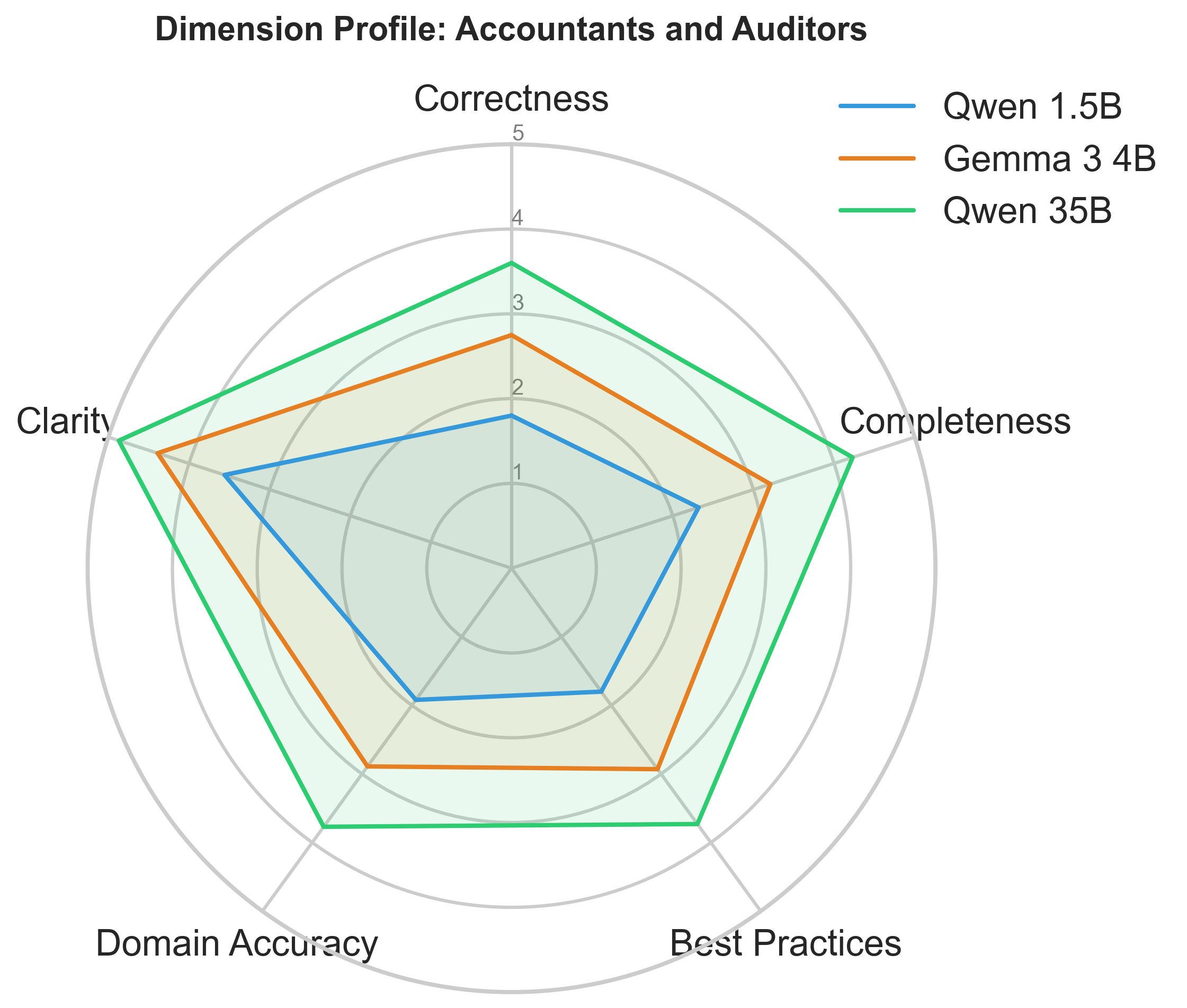
In early testing on roles like "Accountants and Auditors" (SOC 13-2011.00), we observed a massive disparity in how different dimensions scored. The model outputs were exceptionally well-structured, scoring highly on Clarity (often 4.5/5 or higher). However, the Domain Accuracy scores trailed significantly (frequently below 2.5/5).
We call this the "Fluent but Flawed" phenomenon. The model produces professionally formatted, articulate output that effortlessly masks critical domain errors—GAAP misunderstandings, arithmetic hallucinations, and audit blindness.
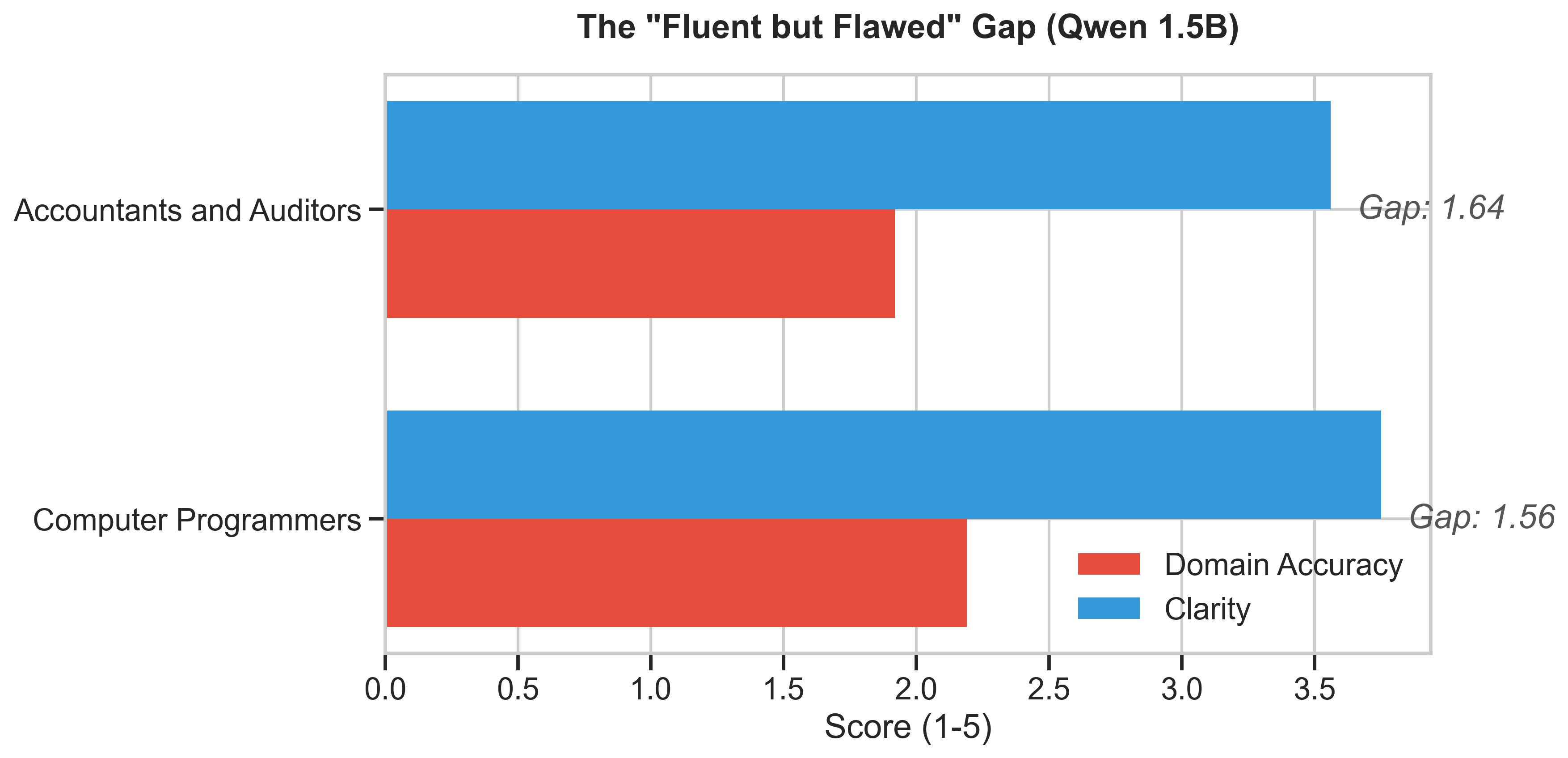
This variance is intrinsically tied to LLM Sycophancy. Reinforcement Learning from Human Feedback (RLHF) often trains models to prioritize user approval and flattery over factual accuracy. In objective roles (like Software Development), this is less problematic because code either compiles or it doesn't. However, for critical advisory roles (Lawyers, Market Researchers, Financial Consultants), professionals are paid to provide friction and objective truth. A sycophantic LLM acts as a "yes-man," dangerously distorting the true level of "exposure" these jobs have to AI automation.
This is a critical finding for policymakers and workforce planners: high subjective quality in an LLM output does not equate to high task feasibility or occupational automation potential.
Multi-Model Scaling: Does More Parameters Mean Less Sycophancy?
To test whether the Fluent-but-Flawed gap is a fundamental model limitation or an artifact of scale, we ran the same 114-occupation pipeline with a second student: Gemma 3 4B (Google DeepMind), served alongside Qwen 35B on the same DGX Spark GPU. This gives us a direct cross-architecture comparison on identical task sets and identical judge criteria.
Key findings from the Gemma 3 4B vs. Qwen 35B comparison:
- Overall exposure scores are broadly similar, suggesting that both models can attempt professional tasks at roughly equivalent apparent quality.
- The Fluent-Flawed gap persists across architectures. Clarity scores remain consistently higher than Domain Accuracy, regardless of which model family is evaluated — confirming this is a structural property of RLHF training, not a model-specific quirk.
- Gemma 3 4B shows a larger average sycophancy gap than the Qwen 35B baseline, consistent with its smaller parameter count and potentially stronger alignment-toward-approval training.
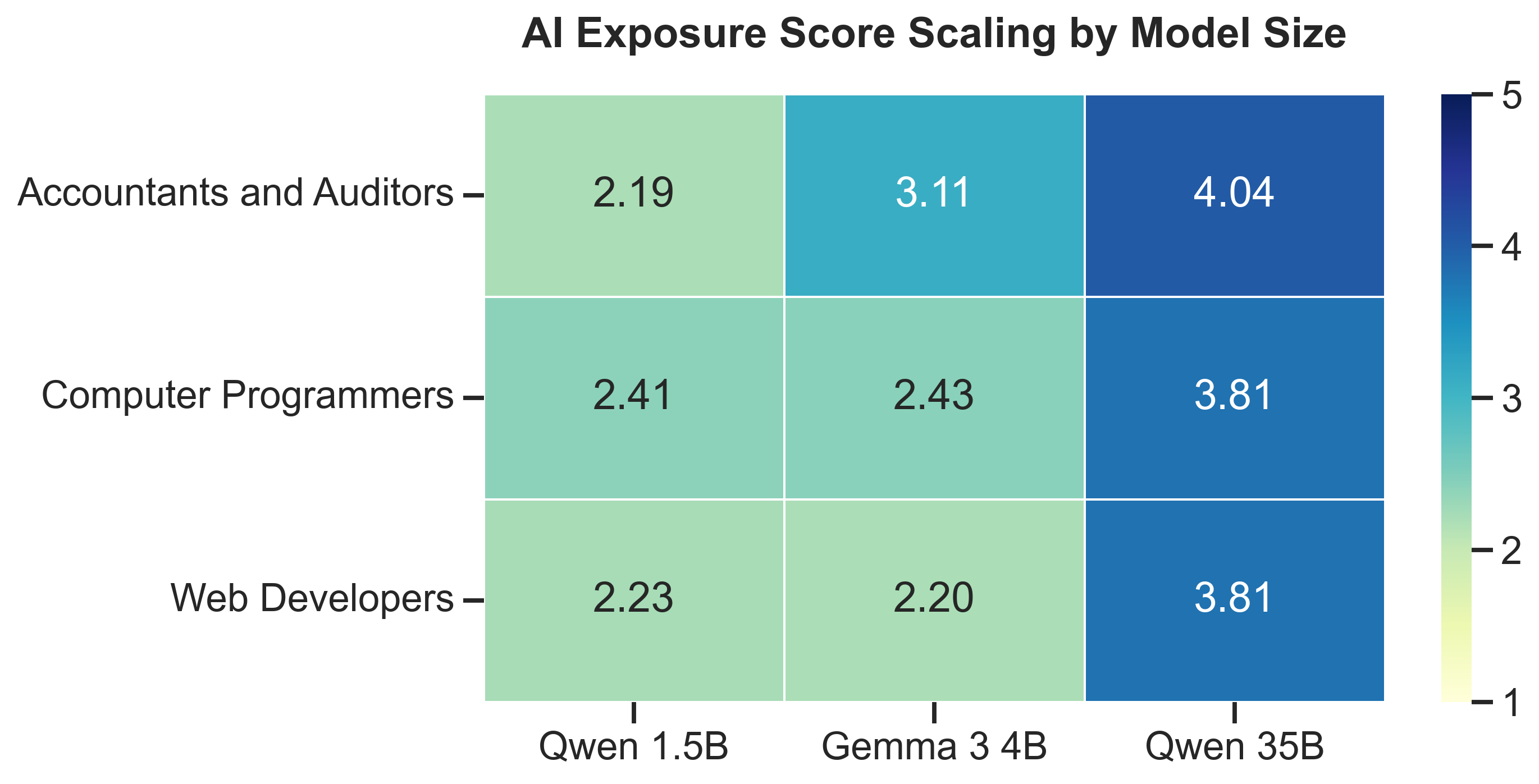
This is a critical finding for policymakers: neither scaling up nor switching model families eliminates the core reliability problem. Larger models become more eloquent, making their domain errors harder for non-experts to catch during human review.
Bridging the Gap: The Autonomy Dimension
Anthropic explicitly distinguishes between tasks where AI replaces human work (automation) and where it assists human work (augmentation). To capture this nuance, we extended our evaluation rubric from 5 to 6 dimensions for the Gemma 3 4B student run, adding Autonomy.
As noted in our DGX guide, a high Clarity + low Autonomy pattern — "sounds great but still needs human oversight" — is exactly the failure mode that standard exposure metrics miss. By grading each response on:
- 5 (Fully Autonomous): Output can be used as-is with no edits.
- 3 (Assistive): Requires light expert review or minor corrections.
- 1 (Human-dependent): Needs substantial rework before professional use.
we can identify precisely which occupations are truly at risk of automation versus those where AI merely augments human expertise.
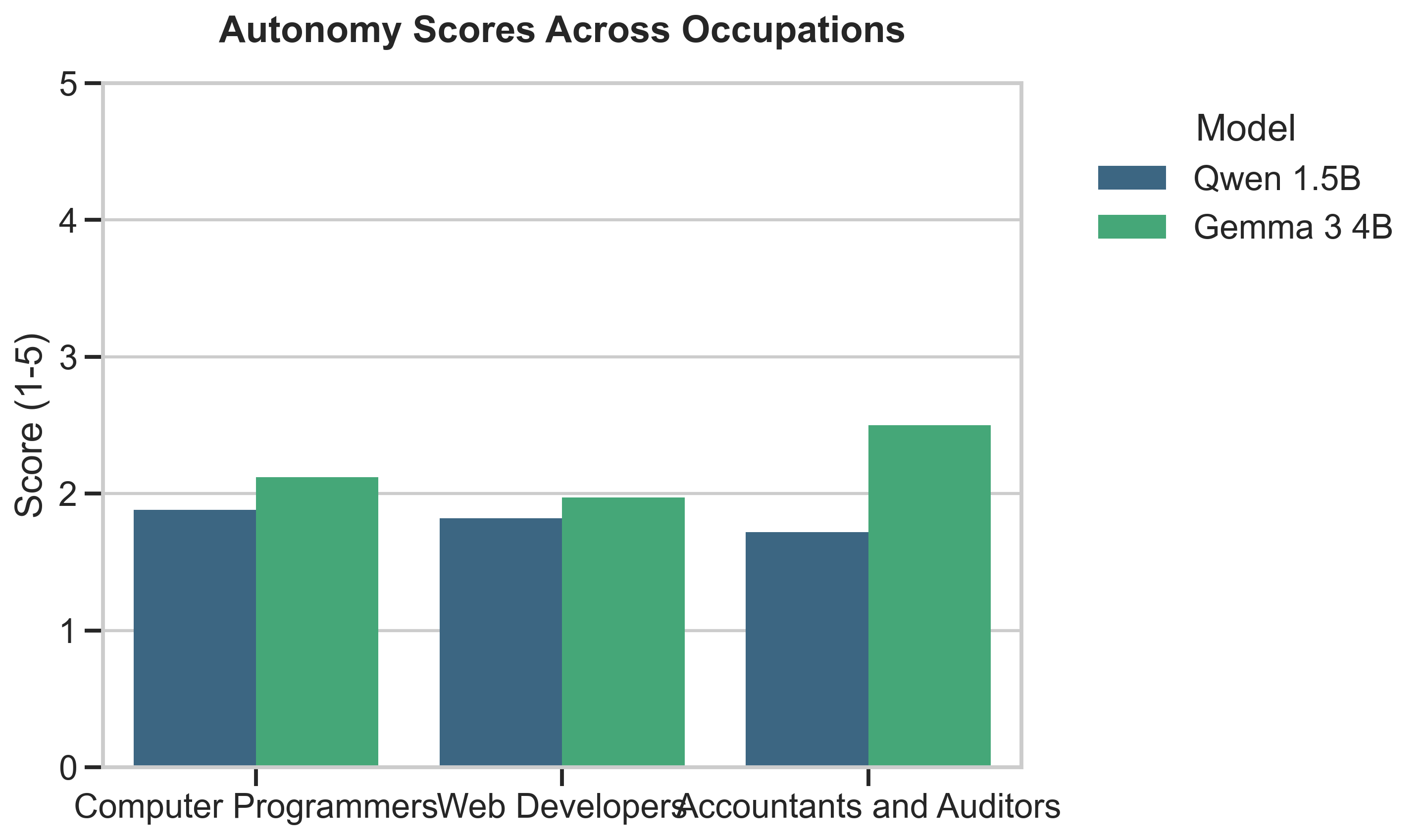
This addresses a critical gap in theoretical exposure metrics, allowing us to see exactly where models struggle to operate independently.
Conclusion & Acknowledgments
Measuring AI exposure requires more than just testing whether a model can generate text related to a job description. We must rigorously test for domain accuracy, autonomy, and the insidious effects of sycophancy.
Our pipeline, ai-exposure-eval, provides a task-level evaluation framework that decomposes capability into distinct dimensions. By making this open-source, we hope to empower researchers to track AI's true capability ceiling as models evolve.
Acknowledgments:
Special thanks to Butterfly Labs intern Yiru Chen, whose foundational job_eval architecture made this extension possible.
Explore the Data & Code: